Doctors & patients are saying about 'A-Fib.com'...
"A-Fib.com is a great web site for patients, that is unequaled by anything else out there."
Dr. Douglas L. Packer, MD, FHRS, Mayo Clinic, Rochester, MN
"Jill and I put you and your work in our prayers every night. What you do to help people through this [A-Fib] process is really incredible."
Jill and Steve Douglas, East Troy, WI
“I really appreciate all the information on your website as it allows me to be a better informed patient and to know what questions to ask my EP.
Faye Spencer, Boise, ID, April 2017
“I think your site has helped a lot of patients.”Dr. Hugh G. Calkins, MD Johns Hopkins,
Baltimore, MD

FAQs: Coping with A-Fib: EECP Therapy
“I’ve heard about an out-patient heart therapy that improves circulation called EECP (Enhanced External Counterpulsation). Would it help me with my A-Fib?”
The goal of Enhanced External Counterpulsation (EECP) therapy is to improve the flow of healthy, oxygenated blood to the heart. It works by opening or forming small blood vessels called collaterals which create natural bypasses around blocked arteries.
It’s FDA cleared, non-invasive, requires no medication and has no recovery period. It improves circulation and decreases inflammation.
Improve Blood Pressure and Circulation
EECP has been used with patients suffering from ischemic heart diseases (e.g. angina and heart failure).
In addition, if you have high blood pressure, EECP can decrease arterial stiffness and hardening of the arteries. It also pumps blood into bone marrow and pushes stem cells to secrete into the circulatory system.
My Experience with EECP
 I recently had an EECP session at Global Cardio Care–West Los Angeles, CA. I can testify that EECP therapy is very powerful and invigorating.
During and after my session. I spoke with Sara Soulati, the CEO of Global Cardio Care, Inc. who is a pioneer in EECP since 1996. (She also helped with research for this article.)
In my case, they found that my arteries were very flexible, so I didn’t get as much benefit as someone with clogged arteries. I can testify from personal experience that EECP feels very effective. It seems like a naturally occurring bypass.
(Global Cardio Care, Inc. has two locations in Los Angeles and offers a free session, see their website).
What Happens During EECP Therapy

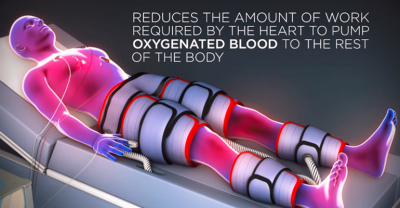
 EECP therapy session: patient with compression cuffs on lower limbs
During an EECP therapy session, you lay on an EECP bed with a pulse-oximetry device on your finger and hooked up to a 12-lead ECG. Heavy-duty air compression pressure cuffs (similar to blood pressure cuffs) are wrapped around each calf, thigh, and the buttocks. The ECG signal synchronizes the sequential squeezing of the cuffs to the rhythm of the patient’s heartbeat.
When the heart is at rest, the blood pressure cuffs squeeze the blood from the lower legs and circulate it throughout the entire arterial system. When the heart pumps, the cuffs deflate rapidly.
EECP therapy increases the blood flow and oxygen back to the heart, reducing the work that the heart has to do. It also improves circulation and strengthens the cardiopulmonary system. A typical session lasts around 1 hour; one course of EECP is usually 35 hours.
EECP: How It Effects Your Body

 Effect of course of EECP therapy: new arteries for blood to flow through
This increased and powerful circulation to the arteries helps develop “collaterals”―new arteries for blood to flow through. Hormones and vasodilators (nerves that cause widening of blood vessels) are released.
Within the arteries, nitric oxide and Vascular Endothelial Growth Factor (VEGF stimulates the formation of blood vessels) are secreted which help the process of collateralization (forming a side branch of a blood vessel). This improves arterial stiffness, increases circulation, and decreases inflammation.
EECP and A-Fib Patients
When I interviewed Sara Soulati of Global Cardio Care, Inc., she shared her experiences with Atrial Fibrillation patients seeking EECP. (Global Cardio is where I had my EECP session.) She recalled how her first A-Fib client came from a referral from Dr. Julian Whitaker (Whitaker Wellness Institute in Newport Beach, CA). Her insights and advice come after conducting EECP on more than 60 A-Fib patients.
Criteria for Best Results: She learned that in order to conduct EECP on someone with A-Fib, one of the criteria for a successful outcome is to have controlled A-Fib as opposed to unstable A-Fib.
Uncontrolled A-Fib has a wider range of heart rates, for example 40 to 150 beats per minute which makes the heart rate very irregular. Whereas controlled A-Fib has a narrower range of heartbeat (50-70 beats/minute).
This allows EECP to work properly, since EECP is triggered by the resting phase of the heartbeat.
EECP Results for A-Fib Patients: Sara Soulati hypothesizes that EECP stimulates electrical conduction of the SA Node to start to conduct and to normalize electrical conduction.

 Sara Soulati
EECP works for those with A-Fib as though it were passive exercise. It lowers heart rate and blood pressure while increasing circulation. About results with A-Fib patients, she writes:
“Since the earliest days when I started doing EECP, we have treated more than 60 A-Fib clients. Not every single person has returned to normal sinus rhythm. I have seen the conversion from A-Fib to normal sinus rhythm first-hand while watching the EKG heart monitor during EECP therapy. About 20% of our clients have had their A-Fib converted back into normal sinus rhythm.”
For those who don’t return to sinus, their heart rate often becomes more controlled and medications can be decreased.

More About EECP Therapy
Is EECP Therapy Safe?
EECP is FDA cleared for the following conditions: angina pectoris, congestive heart failure, cardiogenic shock, and acute myocardial infarction.
Medicare will reimburse for several courses of EECP if you meet the criteria. Most private insurance companies have coverage policies similar to Medicare.
We advise you to talk to your cardiologist or EP before proceeding.
Where can I Find Centers Offering EECP Therapy?
There are nearly 1,000 academic medical facilities, physician practices and stand-alone centers offering EECP throughout the world and in the U.S. See “Locate EECP®Therapy Centers” at the VasoMedical EECP Therapy website.
Read More About EECP Therapy
- Global Cardio Care, Inc. (Sara Soulati)
- Get Pumped Up With EECP by Julian Whitaker. Whitaker Wellness Institute, Medical Center.
- Book: Heal Your Heart with EECP: The Only Noninvasive Way to Overcome Heart Disease by Debra Braverman
 The Bottom Line for A-Fib Patients
 The Bottom Line for A-Fib Patients
A course of EECP therapy may offer a way to improve the flow of healthy, oxygenated blood to your heart. As Sara Soulati of Global Cardio Care, Inc. reports, with EECP therapy, about 20% of her A-Fib clients have converted back into normal sinus rhythm.
The criteria: if your A-Fib is controlled within a narrower range of heartbeat (50-70 beats/minute), or if you have paroxysmal (occasional) A-Fib, you may want to look into a course of EECP therapy. It can improve cardiac function and possibly decrease the need for A-Fib meds.
(If you do try EECP therapy, let me know about your experience! Email me.)
Back to FAQs: Coping with Your A-Fib
Last updated: Wednesday, August 26, 2020