


AF Symposium 2020
Device-Detected A-Fib and Stroke Risk: How Long For a Clot to Form?
by Steve S. Ryan

Daniel Singer MD
How long does it take for a clot/stroke to develop? Dr. Daniel Singer from Massachusetts General Hospital in Boston, MA addressed this most important question both for A-Fib patients and their doctors in his AF Symposium presentation―” Update on Device-Detected AF and Stroke Risk as a Function of AF Burden-Clinical Implications.”
Implanted Devices Help Study Clot Formation
Dr. Singer discussed how implanted rhythm devices such as pacemakers have aided Electrophysiologists (EPs) collect data on clot formation timelines. (Mobile and non-implanted devices such as the Kardia or Apple Watch may open up these studies to a much broader population.)

AF detection devices: minimally invasive devices to permanent implanted devices; source: AHA
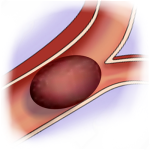 When someone is in A-Fib, blood is not being effectively pumped out of the left atrium. This blood can collect in areas such as the Left Atrial Appendage (LAA) where a pool of blood can form a clot.
When the left atrium starts beating in normal sinus rhythm again, this clot can be pushed downstream into the left ventricle which then pumps this clot into the brain causing an ischemic stroke.
But these clots aren’t formed instantaneously. It takes a while for blood to pool and clot to a significant size. For example, if you have a ten-minute attack of A-Fib, it’s unlikely a clot/stroke will develop.
In cases of permanent A-Fib, normal sinus rhythm doesn’t need to return to move the clot into the ventricle and from there to the brain. This makes patients in permanent A-Fib at high stroke risk.
The ASSERT Study: How Long Does It Take for a Clot to Form?
Dr. Singer discussed the ASSERT study (the Asymptomatic Atrial Fibrillation and Stroke Evaluation in Pacemaker Patients and the Atrial Fibrillation Reduction Atrial Pacing Trial).
The study enrolled 2,580 patients, 65 years of age or older, with hypertension and no history of A-Fib, in whom a pacemaker or defibrillator (ICD) had recently been installed.
Detecting Silent A-Fib: The pacemaker and ICD devices were programmed to detect silent A-Fib (Subclinical Atrial Tachycardia [SCAF]) when the heart rate reached 190 beats or more per minute lasting more than 6 minutes.
The devices were checked at a clinical visit 3 months later. These patients were then followed up for around 2.5 years.
ASSERT Study Result: They found that it took more than 17.72 hours to significantly increase annual stroke risk.
The ASSERT study basically said that it takes around 24 hours of silent A-Fib (SCAF) to develop a serious risk of stroke. Patients with silent A-Fib for over 24 hours had around a 3.1% risk of developing a clot/stroke.
In a later analysis of the ASSERT study by Van Gelder (2017), patients with a SCAF of from 6 hrs to 24 hrs were not significantly different from patients without SCAF.
TRENDS Study, A-Fib and Stroke Risk
Using much the same implanted device strategies as in the ASSERT study, the TRENDS study enrolled patients (2,486) with one or more stroke risk factors. They used a 30-day window to measure silent A-Fib (AT/AF burden).
Findings: Having silent A-Fib for 5.5 hours or more on any 30-day window appeared to double stroke risk (12% of patients in the study had a stroke). (Stroke rates in this study were far below the 4% anticipated annual rate.)
A-Fib Cause or Marker of Stroke Risk? In the TRENDS study (and in the ASSERT study) nearly ¾ of the patients didn’t have A-Fib before the study. This raises the issue of whether A-Fib causes or is just a marker for stroke risk.
Silent A-Fib Hard to Detect
In the ASSERT study, the median time to detect silent A-Fib within the first 3 months was 36 days.
For many patients, just getting an ECG in your doctor’s office or wearing a standard monitor for a few days may not detect if you have silent A-Fib.
This is a major public health issue.
The ASSERT study raises the possibility that patients who suffer ischemic strokes may have silent A-Fib. For those who had an A-Fib-associated stroke, 25% had their A-Fib detected at the time of the stroke. A-Fib-associated strokes account for about 20% of all ischemic strokes.
Unfortunately, from a public health perspective, longer-term monitors like the Medtronic Reveal LINQ (which lasts 3 years) are currently too expensive for screening the general population. Wearable or hand-held ECG monitors may ultimately fill this need.
Pacemakers Don’t Work to Prevent A-Fib
Another finding of the ASSERT study is that pacemakers (continuous overdrive pacing) “does not prevent clinical atrial fibrillation” episodes. (This was the primary question the ASSERT study was constructed to answer.)
Low CHA2DS-VASc and A-Fib Stroke Risk
Dr. Singer pointed out that, even with a high AF burden, there isn’t much stroke risk if the CHA2DS-VASc score is low.
He acknowledged that most Symposium attendees would probably consider that a 1-2-hour episode of silent A-Fib would be a risk factor for stroke.
While others would consider any A-Fib at all as requiring that the patient be put on anticoagulants.
Limitations of the ASSERT Study
The ASSERT study was not designed to study how long it takes for a clot/stroke to form.
The cut-off point at >17.72 hours is somewhat arbitrary. How many patients had strokes from 17.42 hours to 24 hours or 48 hours? What is the precise number of hours in A-Fib where the risk of stroke significantly increases?
ASSERT and TRENDS studied patients with pacemakers and defibrillators. These patients may have other heart problems that the average A-Fib patient doesn’t have.
Editor’s Comments:

Silent A-Fib (Subclinical Atrial Tachycardia [SCAF]) is really dangerous! This is an important public health issue.
I advocate everyone reaching age 65 have long-term monitoring for silent A-Fib. How many strokes could be prevented and lives saved simply by detecting silent A-Fib before it kills or disables people?
Silent A-Fib Is Dangerous―Get Tested at Age 65! If you are 65 or older, get tested for silent A-Fib. In the ASSERT study it took 36 days of monitoring to detect silent A-Fib (SCAF).
However, we don’t currently have rigorous trial evidence that such screening for A-Fib leads to lower stroke risk. The U.S. Preventive Services Task Force doesn’t yet recommend wide scale screening for A-Fib.
Shorter Episodes of A-Fib Not Generally Dangerous: Despite studies such as ASSERT and TRENDS, we still need many more studies on how long it takes for a clot/stroke to form. Probably the most useful data to date comes from the ASSERT study stroke risk where it took around 24 hours of silent A-Fib before clot/stroke risk was significantly increased.
Added 10/11/21: In an article published by Dr. Singer in 2021, he states, “AF greater than 23 hours on a given day was associated with the clearest increase in stroke risk.” Stroke risk was increased most in days 1-5 following an AF episode, but decreased repidly thereafter.
Should All A-Fib Patients be on Anticoagulants? Patients with shorter episodes of A-Fib or those who develop A-Fib after a successful catheter ablation, may not need to be on anticoagulants at all.
Remember that anticoagulants are high risk drugs that shouldn’t be taken unless there is a real risk of stroke.
Hemorrhagic stroke: Another risk of A-Fib is a hemorrhagic stroke where blood bleeds/flows into the brain. For more, see my article, Anticoagulants Increase Risk of Hemorrhagic-Type Strokes
Singer, D.E. et al. Temporal Association Between Episodes of Atrial Fibrillation and Risk of Ischemic Stroke. JAMA Cardiol. Published online September 29, 2021. https://jamanetwork.com/journals/jamacardiology/article-abstract/2784332. doi:10.1001/jamacardio.2021.3702
If you find any errors on this page, email us. Y Last updated: Tuesday, October 12, 2021
Return to 2020 AF Symposium Reports
Related Posts

AUTHOR PROFILE

Our Mission
What Do We Stand For?
Learn moreWe Need You
Help A-Fib.com be an independent source for unbiased patient information.

Support via Amazon
Shop using our linkSupport Our Work
